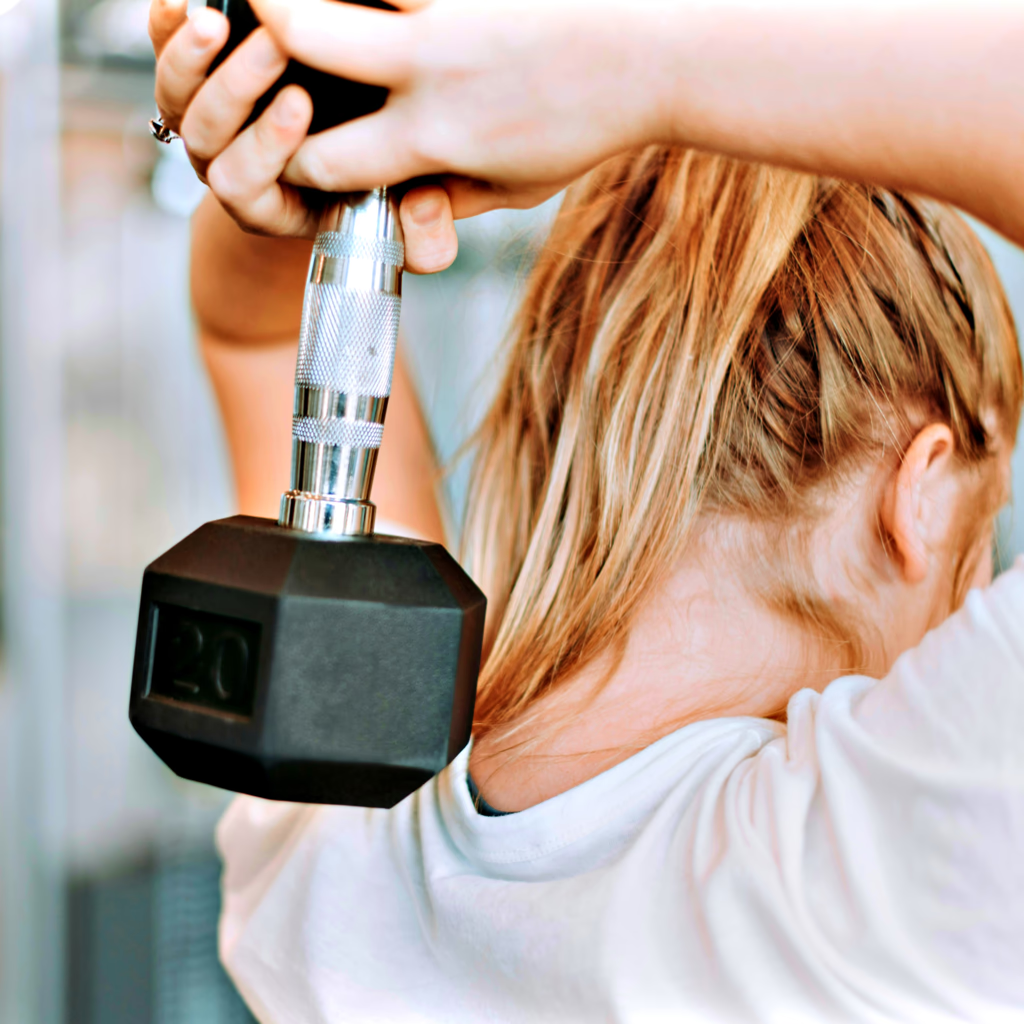
Bodybuilding 2026: What You Must Know + Q&A
Everyone is doing it wrong believing that lifting heavy builds big muscles, but lifting heavy just cuts you off from lifting for long enough to lift heavier.
A bodybuilding workout is built on top of a hour’s worth of jogging endurance, but unlike joggers, you weight yourself down with dumbells.
Like when you were a child, jogging will be slow going, but always improving, and your 3 or 5 ponds per hand will become 7 or maybe even 10.
At which point you sigh up for the gym, where climate is more reliable, and 300 people stare at you, as you now dance with dumbbells.
Dancing is very important, posture, like sets and reps, is yet another myth, with dancing you go from stimulating 2 or 4 muscles, to all muscles.
Your entire body is a system, and muscle isolation, slows down your progress, combined with lifting heavy and chair machines it has devastating effects on progress.
Sets and reps, long rest periods, muscle isolation and machines, are useful instruments for when you just want to fell like you are working out.
And that people still build muscle this way, is not proof that their way works, but that bodybuilding is easy, your body wants to adapt to challenges.
Doing it wrong, as noted, prevents you from lifting longer and heavier, but when you lift light for an hour, there is always room to add more.
You can find faster dance songs, you can mix in the next dumbbell set, or better yet add light wrist-weights to make the next weight easier to get to.
There are less than 30 things that you have to comprehend, for a reliable bodybuilding workout, but only one to get started.
Anybody can do bodybuilding, and everyone starts at a different point, one step past where they are at currently.
So is all you can do is dance with 3 pounds dumbbells to slow country, that is is your perfect start, that is where your body is at.
You cycle your dumbbell exercises, letting your biceps rest, while you lift overhead, letting the dance transform it into a full body exercise.
But you never lift so heavy, that you are forced to stop, your hour, is already a bare minimum.
Disrupting circulation or other wise exhausting yourself, will ruin your excessive.
Just imagine where would you be as a child, if your parents had you learning running with a much too heavy backpack.
If all you could do was 20 steps, your body would have never adapted, you would no be able to run very far.
That is why everyone is wrong, they think the weight of the backpack is how you do it.
But the duration, comes first, it is not even balance of weight and endurance, it is one hour non stop dance, or you’ll feel sand and foolish for never adapting.
Q & A
Q: You say everyone is doing it wrong. Aren't people who lift heavy still building muscle?
A: Yes, and that is exactly the trap. Your body wants to adapt, it is almost desperate to adapt, and it will find a way to grow even when you treat it poorly. But lifting heavy does not prove that heavy lifting works — it proves that bodybuilding is forgiving enough to survive your mistakes. The question is not whether you will grow, but how fast, and for how long. People who lift heavy plateau quickly, injure themselves, and quit. People who lift light for an hour, five days a week, keep adapting for years.
Q: What does "if you have to stop, you are doing it wrong" actually mean?
A: It means the weight you chose is your enemy. The moment you are forced to put the dumbbells down because your muscles gave out, it all aover. Because the signal you sent your body lasted fifteen seconds, and your body, with its four billion years of wisdom, does not know what to do with fifteen seconds. It is not enough information. The duration is the message. If you stop before an hour, your body never received the message.
Q: How light is light enough, and how do I know when to go heavier?
A: The rule is simple and a little poetic: never so heavy that you must stop, and never so light that you could lift more without effort. You want to be working, genuinely working, but never suffering. When the weight starts to feel like nothing — when you catch yourself dancing without noticing the dumbbells — that is your signal. Go up by no more than two and a half pounds. Your body will absorb the change without complaint, without soreness, without drama. That is the entire secret. Tiny steps, taken consistently, compound into something extraordinary.
Q: Why dancing specifically? Can I just do regular sets and reps?
A: You can, and you will still grow, slowly, with long rest periods where your body cools down and your circulation returns to baseline. But when you dance, you cycle through muscle groups naturally — lateral raises rest your biceps, curls rest your shoulders, overhead press rests everything that came before. You never fully stop, so your circulation never drops, your heart stays gently elevated, and every muscle in your body participates in stabilizing your movement. Sets and reps isolate. Dancing integrates. And integration is how your body actually works. You were not designed to sit in a chair machine.
Q: What about beginners who can barely dance for ten minutes?
A: Then ten minutes is your perfect and correct starting point. That is not failure, that is where your body is. A child learning to run does not start with a marathon. You start with what you have, and your only job is to keep showing up. Use an interval timer if it helps — one minute of movement, two minutes of rest, repeated until you have filled thirty minutes. Each week, you reduce the rest and extend the movement, not by forcing it, but by gently asking your body to adapt. It will. That is what bodies do. They are self-repairing, adaptive, biomechanical wonders, and they respond to persistent, gentle challenge every single time.
Q: Do I need a gym for this?
A: Not at first. Jogging with dumbbells is the foundation — three or five pounds per hand, outdoors, at whatever pace you can manage. You earn your way into the gym by first building an hour of endurance. When three pounds feels like nothing then you are ready for weights at the gym.
Q: What are the three dumbbell exercises you keep mentioning?
A: Dumbbell lateral raise, standing dumbbell curls, and overhead shoulder press. These three, cycled continuously while you dance, cover the full upper body in the correct sequence and allow each muscle group to rest while the others work. You do not need to think about which muscle you are targeting. You just keep moving through the cycle, staying with your music, and let the hour do its work. Muscle isolation and complex programming are solutions to problems you do not have.
Q: What about soreness? I remember lifting being painful.
A: The first two weeks will ache. That is your body waking up, re-activating systems that have been quiet for a long time. But here is what every experienced lifter will confirm if you ask them: nobody remembers it. It is a brief chapter at the very beginning of a long story, and it does not return. Normal bodybuilding — lifting light for an hour to music you love — does not hurt. It feels like uncoiling. It feels like flying. The soreness you remember was probably from lifting too heavy, too fast, with too little endurance beneath it.
Q: You mention wrist weights and weight vests. Where do those fit in?
A: They are elegant solutions to the hardest part of the program — the gap between dumbbell sizes. When five pounds is too easy and seven and a half is too hard, light wrist weights bridge that gap and make the jump feel almost unnoticeable. The weight vest is different: you wear it after the gym, during your ordinary day, doing ordinary things. Large people are often muscular precisely because their bodies carry extra weight everywhere they go. The vest gives you that advantage deliberately, gently, and for free.